




Rebuilding the Bay: The Work of the Oyster Recovery Partnership
|
|
Time to read 4 min
Put 'Em Back
Help us replant oyster beds and clean our coastal waters.
|
|
Time to read 4 min
In the Chesapeake Bay, everything starts at the bottom.Out of sight, beneath the tides and shifting currents, oyster reefs are doing the work that keeps the entire system in balance filtering water, creating habitat, and supporting the life that defines this fishery. When those reefs disappear, the effects ripple outward. Water quality declines. Habitat shrinks. The system begins to lose its footing. Restoring those reefs isn’t simple but it is possible. And across Maryland’s waterways, the Oyster Recovery Partnership (ORP) is leading that effort, rebuilding one of the most important ecological foundations of the Bay.
The Oyster Recovery Partnership is a Maryland-based nonprofit focused on restoring native oyster populations throughout the Chesapeake Bay. Working alongside scientists, watermen, government agencies, and local communities, Oyster Recovery Partnership has become a driving force behind some of the most impactful restoration efforts in the country. Their work spans the full lifecycle of restoration.
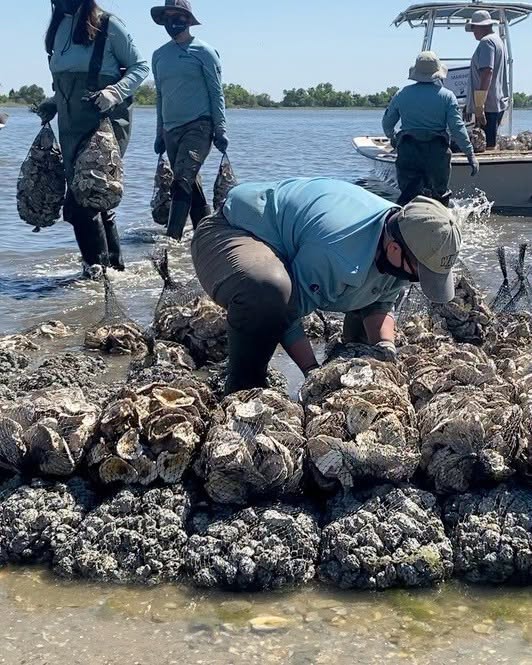
ORP builds large-scale sanctuary reefs, rebuilds public fishery reefs, supports sustainable aquaculture, and operates one of the region’s most extensive shell recycling networks. That recycling effort is a critical piece of the puzzle. Through partnerships with restaurants, caterers, and community drop sites, ORP collects thousands of bushels of used oyster shells each year keeping them out of landfills and returning them to the water where they can serve a second purpose.
Once collected, the shells are cured and later deployed in restoration projects across the Bay. This provides the hard substrate that oyster larvae need to attach to and grow—rebuilding reefs from the ground up. And the scale of that work is significant. Since its founding, ORP has helped plant billions of oysters and restore thousands of acres of reef habitat throughout Maryland’s waterways. But beyond the numbers, what stands out is how they’ve built a model that brings people into the process of turning restoration into something.
The Chesapeake Bay is one of the most important estuaries in the United States, supporting fisheries, coastal communities, and an entire network of life that depends on clean, balanced water. Oysters are at the center of that system. As filter feeders, they remove excess nutrients, sediment, and pollutants from the water improving clarity and overall water quality. When oyster populations are healthy, the benefits extend far beyond the reef itself, supporting seagrass, fisheries, and the broader ecosystem.
Reefs also create structure in an otherwise soft-bottom environment. They provide habitat for fish, crabs, and shrimp, while helping stabilize shorelines and reduce erosion from waves and storms. But for decades, those systems have been under pressure. That’s why large-scale restoration efforts like those led by Oyster Recovery Partnership have become so important. In 2014, a region-wide commitment was made to bring oysters back at scale across the Chesapeake Bay, setting ambitious goals to restore entire tributaries not just individual reefs.
Focusing on key Maryland waterways like the Tred Avon, Little Choptank, Manokin, Upper St. Mary’s, and Harris Creek, ORP and its partners have spent the past decade rebuilding reef systems from the ground up. And in 2025, that effort reached a major milestone completing Maryland’s 10-year tributary restoration strategy, with oyster populations fully restored in five Chesapeake Bay tributaries. It’s one of the most ambitious and successful oyster restoration efforts ever undertaken. And it’s proof that with the right approach, large-scale ecosystem recovery is possible.
Efforts like these don’t happen in isolation. They rely on collaboration, organizations, communities, and partners all working toward the same goal. Through the Toadfish Conservation Coalition, we’ve had the opportunity to support ORP’s restoration efforts and contribute to the work they’re doing across the Chesapeake Bay. It’s a partnership built on a shared belief in the importance of oysters not just as a species, but as the foundation of healthy coastal systems.
One of the ways that support comes to life is through ORP’s “Shuck Like a Pro” events. These hands-on experiences give participants the opportunity to learn the art of oyster shucking while gaining a deeper understanding of why oyster restoration matters in the first place. It’s equal parts experience and education, connecting people directly to the resource in a way that sticks. By providing oyster shuckers for these events, we’re helping support that connection. And with proceeds going directly toward ORP’s restoration work, every event contributes back to the Bay helping fund reef construction, expand shell recycling efforts, and continue the progress being made across the region. It’s a simple but powerful idea: the more people understand the resource, the more invested they become in protecting it.
Restoring a system as complex as the Chesapeake Bay takes time, consistency, and a long-term commitment to doing things the right way. Organizations like the Oyster Recovery Partnership are showing what that looks like rebuilding reefs at scale, improving water quality, and bringing communities into the process along the way. And the results are already taking shape.
With each reef restored and each shell returned, the Bay becomes more resilient—better able to support the life, fisheries, and traditions that depend on it. Because when the foundation is rebuilt, everything above it has a chance to thrive again. #PutEmBack
Question 1
Lorem ipsum dolor sit amet consectetur adipisicing elit. Illum neque eaque, autem sit soluta, voluptatum libero magnam tempore ullam at harum vel, ad reprehenderit, nemo veniam quas in voluptas hic. Lorem ipsum dolor, sit amet consectetur adipisicing elit. Natus id officia omnis suscipit aut architecto repellat a quia eaque reiciendis blanditiis perferendis hic, nihil, mollitia. Iste velit aperiam, numquam dolorem.
Question 2
Lorem ipsum dolor sit amet consectetur adipisicing elit. Illum neque eaque, autem sit soluta, voluptatum libero magnam tempore ullam at harum vel, ad reprehenderit, nemo veniam quas in voluptas hic. Lorem ipsum dolor, sit amet consectetur adipisicing elit. Natus id officia omnis suscipit aut architecto repellat a quia eaque reiciendis blanditiis perferendis hic, nihil, mollitia. Iste velit aperiam, numquam dolorem.


