




Marsh Madness 2026: The Lifecycle of an Oyster with Toadfish
|
|
Time to read 6 min
Put 'Em Back
Help us replant oyster beds and clean our coastal waters.
|
|
Time to read 6 min
At Toadfish, we’ve always said that putting ’em back is about more than a slogan - it’s about understanding the full journey of the species that sustain our coastal waters. This year, Marsh Madness is centered around our favorite organism and the winding path it takes through our communities: the oyster. From the moment it’s carefully raised on a local oyster farm, to being harvested and served at one of Charleston’s favorite raw bars, to its shell finding a second life in restoration efforts; the oyster’s story doesn’t end at the table. It continues through the hands of farmers, chefs, conservationists, volunteers, and community members working together to return it to the waters where it belongs.
Over the next four weeks, we’ll follow that journey step by step. We’ll meet the professionals who steward oysters at every stage of their lifecycle, roll up our sleeves alongside volunteers and biologists, and show how a single shell can help rebuild entire ecosystems. From farm to table to reef, this is the story of how we keep putting ’em back.
This year for Marsh Madness, just like last, we’re diving into four weekly themes centered around conservation, education, and advocacy:
Week 1 - From Farm to Table; and Beyond
Week 2 - Sorting, Quarantining, and Building the Future
Week 3 - Community in Action
Week 4 - Bringing it Full Circle - How Why Oyster Lifecycle Works
We’re kicking off Marsh Madness on the water with Tom Bierce of Charleston Oyster Farm, where the oyster’s lifecycle begins. Out on the boat, Tom walks us through the process of growing oysters from seed to harvest size, explaining how careful monitoring of salinity, water quality, and tidal flow ensures healthy, resilient shellfish. Oyster farming is one of the most sustainable forms of aquaculture in the world, and these farms don’t just produce incredible seafood; they actively filter and improve the waters they grow in. Watching the harvest firsthand reminds us that every oyster starts with intention, stewardship, and respect for the ecosystem.
From the farm, we head straight to the raw bar at 167 Raw, where Head Chef Bailey Campbell shares how their team honors the oyster long after it’s shucked. At restaurants like 167 Raw, used shells aren’t tossed in the trash. They’re carefully separated and placed into SCDNR recycling bins, ready for pickup. It’s a simple but powerful partnership that ensures thousands of shells don’t end up in landfills. Instead, they’re collected curbside by SCDNR’s oyster retrieval team, who run semiweekly routes across Charleston to gather these “used” oysters and bring them back for processing.
Riding along with SCDNR, you quickly realize that the oyster’s story doesn’t end when dinner is over. Bin after bin is loaded with shells that will soon begin their next chapter. What might look like waste is actually the foundation for future reefs. And this first week sets the tone for the month ahead: every step in the oyster’s lifecycle is connected, and every person involved plays a role in putting it back.
Once the shells return to SCDNR, the real hands-on conservation work begins. In Week 2 of Marsh Madness, we learn that before recycled shells can go back into our waterways, they must be quarantined in the sun for at least six months to eliminate bacteria and ensure they’re safe for reuse. During this time, volunteers and staff sort through thousands of pounds of shells, removing any trash that accidentally made its way into the bins. From napkins and plastic utensils to oyster knives and shucking gloves, you’d be surprised what gets mixed in, and and every piece must be removed before restoration begins.
Working alongside DNR, we help sift through the piles, separating shell from debris and preparing them for their next life as “green shell.” These cured shells are one of the most valuable resources in oyster restoration because baby oysters, called spat, need hard substrate to attach to during their larval stage. Without shell, there is no reef. What was once served on a platter now becomes the literal building block of a new ecosystem.
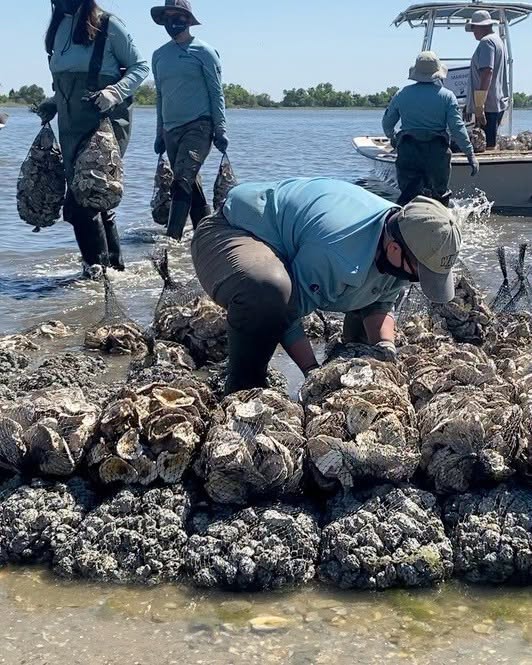
Many of these shells will be used to construct Manufactured Wire Reefs, or MWRs. These wire mesh structures are filled with recycled oyster shell and coconut husk, creating elevated, stable habitat that promotes oyster settlement and shoreline stabilization. Building MWRs alongside conservationists and volunteers makes it clear: restoration isn’t abstract. It’s tangible, hands-on, and powered by community effort.
In Week 3 of Marsh Madness, we widen the lens and invite the community to step directly into the lifecycle story. On March 13th, we’re hosting a beach cleanup at Folly Beach to remove plastic and debris before it can make its way into our waterways. Clean water is essential for healthy oyster reefs, and keeping our beaches free of trash is one more way we protect the environments oysters depend on to thrive.
As the week continues, we’ll deploy newly built MWRs into local waterways, placing recycled shell back where it belongs. Watching these structures settle into the marsh is a powerful moment - it represents months of farming, dining, collecting, sorting, and building all coming full circle. These reefs will soon host new generations of oysters, filtering water and creating habitat for fish, crabs, and countless other species.
We’ll also highlight additional conservation efforts happening beyond oysters, reinforcing that ecosystem health is interconnected. Clean beaches, responsible fishing, water quality monitoring; they all support the same goal. When we protect the broader system, oysters, and the species that rely on them, have a fighting chance.
In our final week of Marsh Madness, we’ll recap the oyster’s remarkable journey from farm to reef and reflect on the professionals, volunteers, chefs, and conservationists who make it possible. From Tom’s oyster cages to Bailey’s recycling bins, from SCDNR’s pickup routes to MWR deployment days, every step is part of one continuous cycle of stewardship. The oyster’s lifecycle doesn’t stop at harvest; it evolves into restoration.
We’ll also spotlight water quality testing efforts in Tampa Bay alongside Tampa Bay Waterkeeper, connecting the dots between oyster habitat restoration and measurable improvements in coastal resilience. Oysters are natural water filters, capable of cleaning up to 50 gallons of water per day, and expanding reef systems strengthens entire estuaries. Monitoring that progress helps ensure our restoration work has lasting impact.
This final week of Marsh Madness is about reflection, but it’s also about momentum. The lifecycle of the oyster is a reminder that nothing in nature operates in isolation. When communities, restaurants, farmers, nonprofits, and everyday water lovers work together, we can restore what was lost - and build something stronger in its place.
Marsh Madness is our annual reminder that conservation isn’t a one-day event; it’s a continuous cycle, just like the oyster’s lifecycle itself. From farm to table to reef, every stage offers an opportunity to act with intention and gratitude for the coastal ecosystems we love. This month, we’ve had the privilege of working alongside farmers, chefs, biologists, and volunteers who prove that restoration is possible when communities come together.
As you follow along throughout March, remember that every small action adds up - recycling shells, joining a cleanup, supporting restoration-focused brands, or simply spreading awareness. Together, we can keep putting ’em back where they belong and ensure our waters remain vibrant for generations to come. Stay tuned to Toadfish’s socials and emails as Marsh Madness unfolds, and as always, let's #PutEmBack!
Question 1
Lorem ipsum dolor sit amet consectetur adipisicing elit. Illum neque eaque, autem sit soluta, voluptatum libero magnam tempore ullam at harum vel, ad reprehenderit, nemo veniam quas in voluptas hic. Lorem ipsum dolor, sit amet consectetur adipisicing elit. Natus id officia omnis suscipit aut architecto repellat a quia eaque reiciendis blanditiis perferendis hic, nihil, mollitia. Iste velit aperiam, numquam dolorem.
Question 2
Lorem ipsum dolor sit amet consectetur adipisicing elit. Illum neque eaque, autem sit soluta, voluptatum libero magnam tempore ullam at harum vel, ad reprehenderit, nemo veniam quas in voluptas hic. Lorem ipsum dolor, sit amet consectetur adipisicing elit. Natus id officia omnis suscipit aut architecto repellat a quia eaque reiciendis blanditiis perferendis hic, nihil, mollitia. Iste velit aperiam, numquam dolorem.


