




A Pathway for Oysters: Restoring Habitat in the Lower Cape Fear
|
|
Time to read 7 min
Put 'Em Back
Help us replant oyster beds and clean our coastal waters.
|
|
Time to read 7 min
The Cape Fear River has been shaped by oysters for generations. Below its dark waters, sprawling oyster reefs once created hard, living structure along the river bottom, giving juvenile oysters a place to grow, providing habitat for fish and other marine life, and helping maintain the health of the surrounding ecosystem. Over the decades, however, much of that habitat has disappeared.
Pollution, overharvesting, disease, sedimentation, habitat loss, and changes to the river itself have all contributed to a significant decline in the Lower Cape Fear’s oyster populations. But importantly, the oysters haven’t given up on the river. Oyster larvae are still present in its waters. What many of them are missing is a suitable place to land, attach, and grow. The North Carolina Coastal Federation and its partners are working to change that.
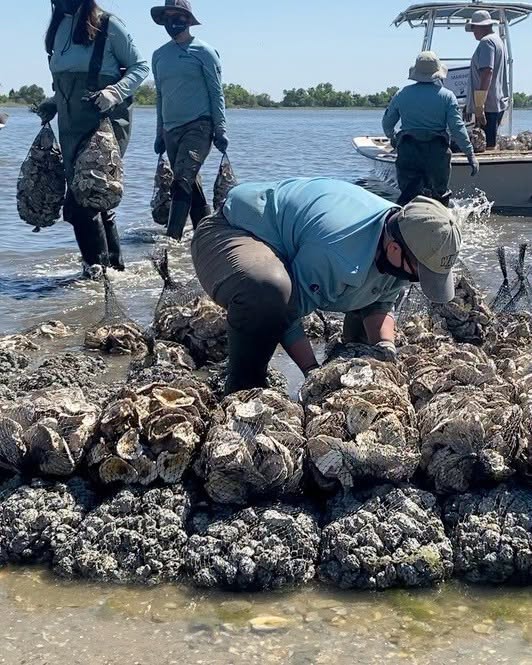
Through the Lower Cape Fear Oyster Pathway, a multi-year collaborative restoration effort, the Federation is working to reconnect and rebuild oyster habitat throughout the river, creating a pathway of healthy reef structure that will benefit oysters, fisheries, water quality, and the broader Cape Fear ecosystem for years to come. It’s ambitious work. It’s collaborative work. And it’s exactly the kind of coastal restoration we love to see.
Founded in 1982, the North Carolina Coastal Federation is a member-supported nonprofit dedicated to protecting and restoring the state’s coast. Over more than four decades, the Federation has worked in the field restoring coastlines, improving water quality, protecting coastal land, educating communities, and bringing together businesses, government agencies, conservation organizations, and everyday North Carolinians around a healthier coast.
Today, the Federation has around 16,000 supporters and directly reaches nearly 300,000 people each year. Its accomplishments include helping preserve more than 10,000 acres of threatened coastal land, advancing protections for coastal water quality, and restoring miles of coastline. And their work doesn’t stop with oysters.
The Federation tackles marine debris, stormwater and water quality issues, salt marsh and shoreline restoration, coastal management, environmental education, and more. It’s a comprehensive approach built around a simple reality: healthy coastal ecosystems are connected. You can’t protect the fish without protecting their habitat, and you can’t restore habitat without paying attention to the quality of the water surrounding it.
Oysters happen to sit right in the middle of that equation.
If you’ve followed Toadfish for a while, you probably know we can talk about oysters all day. And in North Carolina, there’s plenty to talk about.
The Federation describes the importance of oysters through three simple words: food, filter, and fish habitat. Oysters support commercial and recreational fisheries, filter pollutants and excess sediment from coastal waters, and create complex reef habitat that supports everything from southern flounder and shrimp to clams and blue crabs. According to the Federation, a healthy oyster reef can provide habitat for more than 300 different adult and juvenile organisms, while an individual adult oyster can filter as much as 50 gallons of water per day.
Unfortunately, North Carolina’s oyster populations have taken a serious hit. The Federation estimates that current oyster harvest levels—used as the state’s best available measure of oyster populations—are only around 15–20% of historic harvest levels. Poor water quality, habitat loss, disease, predation, natural disasters, low recruitment, and harvest pressure have all played a role.
The good news is that restoration is happening at an impressive scale. In 2024 alone, the Federation and its partners built 40 acres of new oyster habitat, monitored 480 million oysters within the oyster sanctuary network, and recycled 5,336 bushels of oyster shell along the North Carolina coast.
Bringing those populations back requires more than simply putting oysters in the water.
Baby oysters, or spat, spend part of their early lives floating freely through the water column. To survive, they eventually need to find a hard surface where they can attach and grow. In areas where historic reefs have disappeared, that suitable surface can be difficult to find.
Build the foundation, however, and nature has an opportunity to take it from there. That brings us back to the Cape Fear.
The vision behind the Lower Cape Fear Oyster Pathway is bigger than restoring one isolated reef. The pathway is part of the Federation’s broader Lower Cape Fear River Blueprint, an effort focused on improving the health and water quality of the river and its surrounding watershed. The long-term goal is to create a network of oyster habitat extending downriver toward Bald Head Island, connecting remaining natural reefs with constructed reefs built by conservation partners throughout the region.
Think of it less like building a single reef and more like reconnecting pieces of an ecosystem.
One major step forward took place near Carolina Beach State Park, where the Federation and North Carolina Division of Marine Fisheries worked to expand an existing one-acre artificial reef by another four acres. Crews deployed roughly 2,100 tons of recycled, crushed concrete to create hard reef structure where oyster larvae can settle. The broader restoration work in the area also includes 10 acres of wetland restoration, 2,000 feet of living shoreline, oyster reef sills, and salt marsh habitat along the river.
There’s another encouraging piece of this story: oysters are already showing that this approach can work.
Materials previously placed at the artificial reef site have remained productive through multiple hurricanes, continuing to support oyster populations while also providing fishing opportunities. And because the site sits close to shore, the reef can benefit anglers accessing the area by kayak or from land as well. Now, the work continues.
As this multi-year collaborative effort moves forward, the project is expected to restore more than ten acres of habitat—helping fill gaps in the pathway and creating more of the hard structure oysters need to establish themselves throughout the Lower Cape Fear.
For a river that once held extensive oyster reefs, that represents an opportunity to put back some of what has been lost.
Through the Toadfish Conservation Coalition, we’re contributing funds to support the Lower Cape Fear Oyster Pathway and the restoration work surrounding it.
The Oyster Pathway brings together the North Carolina Coastal Federation and a larger network of agencies, researchers, conservation organizations, and community partners around a long-term vision for the river. It isn’t a quick project designed to create a temporary result. It's an investment in rebuilding habitat that can grow, reproduce, protect, filter, and support life long after the restoration work itself is finished.
Our Put ’Em Back mission began with oyster habitat restoration, and the Toadfish Conservation Coalition exists to support organizations doing meaningful work for the coastal ecosystems we all enjoy. Helping create more oyster habitat in a river that still has oyster larvae searching for somewhere to grow feels like putting that mission exactly where it belongs.
One of the things we appreciate most about the North Carolina Coastal Federation is that protecting the coast isn't treated like a spectator sport. There are plenty of ways to get your hands dirty.
The Federation hosts volunteer restoration projects and community events throughout the year. You can help recycle oyster shells, participate in restoration work, support the Federation as a member, attend educational events, or even encourage restaurants in your community to recycle their shells rather than send them to a landfill. Their Restaurant to Reef program also provides opportunities for volunteers to get directly involved in oyster shell recycling.
Those actions matter because projects like the Oyster Pathway aren't built by one organization alone. They're built by people who recognize what healthy coastal waters give us.
From the oyster reefs beneath the Cape Fear to the marshes lining its banks, this river supports fisheries, wildlife, communities, and countless days spent outside and on the water. Restoring more than ten acres of habitat won't happen overnight, and the work won't end when those acres are complete. That's the point.
Real restoration is built for the long haul.
We're proud to support the North Carolina Coastal Federation as they keep building that future—reef by reef, acre by acre, all the way down the Cape Fear.
#PutEmBack
Question 1
Lorem ipsum dolor sit amet consectetur adipisicing elit. Illum neque eaque, autem sit soluta, voluptatum libero magnam tempore ullam at harum vel, ad reprehenderit, nemo veniam quas in voluptas hic. Lorem ipsum dolor, sit amet consectetur adipisicing elit. Natus id officia omnis suscipit aut architecto repellat a quia eaque reiciendis blanditiis perferendis hic, nihil, mollitia. Iste velit aperiam, numquam dolorem.
Question 2
Lorem ipsum dolor sit amet consectetur adipisicing elit. Illum neque eaque, autem sit soluta, voluptatum libero magnam tempore ullam at harum vel, ad reprehenderit, nemo veniam quas in voluptas hic. Lorem ipsum dolor, sit amet consectetur adipisicing elit. Natus id officia omnis suscipit aut architecto repellat a quia eaque reiciendis blanditiis perferendis hic, nihil, mollitia. Iste velit aperiam, numquam dolorem.


