



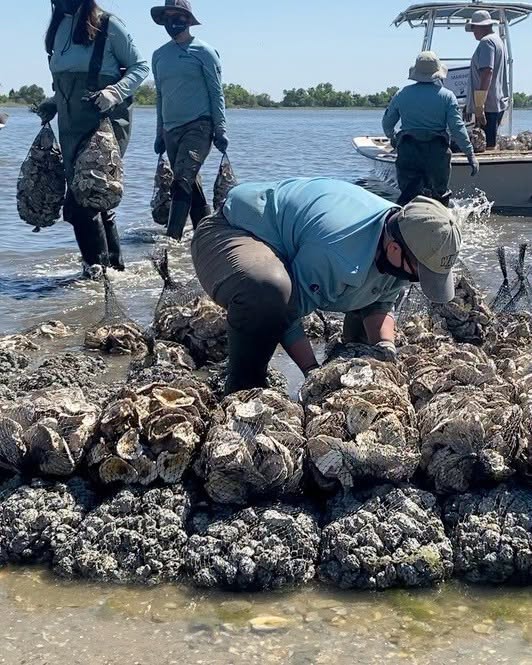

Marsh Madness Week 1: From Farm to Table; and Beyond
|
|
Time to read 6 min
Put 'Em Back
Help us replant oyster beds and clean our coastal waters.
|
|
Time to read 6 min
When we talk about the lifecycle of an oyster, we’re talking about far more than biology. We’re talking about people. About early mornings on the water, long shifts behind a raw bar, and quiet curbside pickups before the city wakes up. We’re talking about farmers, chefs, and conservationists who each play a critical role in ensuring oysters don’t just feed our communities - they help restore them.
For Week 1 of Marsh Madness, we followed the oyster’s journey from its very beginning at Charleston Oyster Farm, to one of its most celebrated destinations at 167 Raw, and finally onto an SCDNR pickup route with Brian, who helps give every shell a second life. Through conversations with these key players in the oyster lifecycle, we begin to understand why oysters are so important - and how each piece of the puzzle works together to keep our coastal waters thriving.
This year for Marsh Madness, just like last, we’re diving into four weekly themes centered around conservation, education, and advocacy:
Week 1 - From Farm to Table; and Beyond
Week 2 - Sorting, Quarantining, and Building the Future
Week 3 - Community in Action
Week 4 - Bringing it Full Circle - How Why Oyster Lifecycle Works
Our journey began where every great oyster story should: on the water. Tom Bierce, founder of Charleston Oyster Farm, didn’t stumble into aquaculture by accident. After studying Marine Science and Coastal Geology at Coastal Carolina University, Tom moved to Folly Island, where he led eco paddleboard tours through the marsh, teaching visitors about tidal creeks, spartina grass, and the ecosystems that make the Lowcountry so unique. His appreciation for coastal environments only deepened as he diversified his skill set - working in marine construction, salvaging and repairing boats, building docks, and commercial diving.
By 2014, Tom recognized a growing problem: restaurants were increasingly reliant on wild-harvested oysters to meet demand. With wild stocks under pressure, he saw an opportunity, and a responsibility, to help create a more sustainable solution. That’s when he began building Charleston’s first oyster farm, specializing in what he proudly calls “local. salty. singles.”
Out on the farm with Tom, we pulled cages holding oysters at every stage of development. Some were no larger than a coin, others fully formed and market-ready. Oyster farming is a carefully managed process. Seed oysters are placed in floating cages that allow for optimal water flow, ensuring they receive the nutrients they need while naturally filtering the surrounding waters. As they grow, the cages are regularly tumbled to strengthen their shells and promote the deep-cupped shape chefs love.
Unlike many forms of aquaculture, oyster farming doesn’t require feed, freshwater input, or chemical additives. Oysters survive entirely on naturally occurring phytoplankton, and in doing so, they actively improve water quality. A single adult oyster can filter up to 50 gallons of water per day. Multiply that across thousands of farmed oysters, and the environmental benefit becomes clear.
As we headed back to the dock, Tom loaded freshly harvested oysters destined for some of Charleston’s most beloved restaurants. The lifecycle was already moving forward, from farm to table, but as we’d soon learn, it doesn’t stop there.
After learning where oysters begin, we traveled to one of their most likely destinations: the restaurant. There’s no better place to witness Charleston’s oyster culture than 167 Raw. Inside the bustling raw bar, Head Chef Bailey Campbell walked us through not only the culinary side of oysters, but their commitment to conservation. On any given night, thousands of oysters are shucked and served. Without intention, those shells could easily end up in the trash.
Instead, 167 Raw has built shell recycling into their daily rhythm. At the raw bar, shuckers work over metal trays, carefully opening oysters and plating them for guests. As the trays fill with empty shells, they’re cleared into designated SCDNR recycling buckets kept just beneath the bar. Throughout service, discarded shells are transferred into these buckets rather than trash bins. Once full, the buckets are sealed and stored in the restaurant’s walk-in cooler to keep them contained and clean.
Twice a week, those buckets are placed on the curb, ready for pickup. It’s a simple process, but it requires intentional effort from the entire staff. In a fast-paced restaurant environment, convenience often dictates behavior — and it would be far easier to toss shells in the trash. Instead, 167 Raw makes the extra effort to steward our waterways and not “chuck their shucks,” preserving hundreds of thousands of viable shells for future restoration.
The oysters may have been enjoyed on ice with mignonette, but their shells are already preparing for their next chapter.
Before most of Charleston finishes its first cup of coffee, Brian with SCDNR is already on the road. Two mornings each week, Brian drives a truck and open trailer across the city, following a carefully mapped route of participating restaurants. His mission is straightforward but vital: retrieve the recycled oyster shells and replace the buckets so the cycle can continue uninterrupted.
We joined him on one of these early runs, watching as he lifted heavy buckets from sidewalks and kitchen back doors, dumping their contents into the open trailer. The sound of shells cascading into the pile is unmistakable; a reminder that what looks like waste is anything but. Once emptied, clean buckets are left behind for the next round of service. This operation saves hundreds of thousands of shells each week. Without it, those shells would be lost to landfills. Instead, they’re redirected back into the conservation pipeline.
After completing his route, Brian transports the trailer full of shells back to SCDNR facilities, where they’ll begin the next phase: quarantining and preparation for use in habitat restoration. But that’s a story for Week 2. For now, what stands out most is the coordination. Farmers grow them. Chefs serve them. Restaurants store them. And conservationists retrieve them. Each step is interconnected, and without any one of them, the lifecycle would break.
Week 1 of Marsh Madness reminds us that conservation isn’t one grand gesture - it’s a series of intentional actions carried out by people who care deeply about the coast. From Tom’s floating cages in Charleston Harbor to Bailey’s recycling buckets at the raw bar, to Brian’s early morning pickup route, every stage of the oyster’s journey matters. Oysters are more than a menu item. They’re natural water filters, shoreline stabilizers, and habitat builders. And when their shells are returned to the water, they become the foundation for new reefs that will support future generations of marine life.
As Marsh Madness continues, we’ll follow those shells into their next chapter - sorting, quarantining, and ultimately building Manufactured Wire Reefs that help restore our marshes. Stay tuned for Week 2 as we roll up our sleeves with SCDNR and dig into the hands-on work that turns “used” shells into thriving habitat. From farm to table to reef, this is how we keep putting ’em back. #PutEmBack
Question 1
Lorem ipsum dolor sit amet consectetur adipisicing elit. Illum neque eaque, autem sit soluta, voluptatum libero magnam tempore ullam at harum vel, ad reprehenderit, nemo veniam quas in voluptas hic. Lorem ipsum dolor, sit amet consectetur adipisicing elit. Natus id officia omnis suscipit aut architecto repellat a quia eaque reiciendis blanditiis perferendis hic, nihil, mollitia. Iste velit aperiam, numquam dolorem.
Question 2
Lorem ipsum dolor sit amet consectetur adipisicing elit. Illum neque eaque, autem sit soluta, voluptatum libero magnam tempore ullam at harum vel, ad reprehenderit, nemo veniam quas in voluptas hic. Lorem ipsum dolor, sit amet consectetur adipisicing elit. Natus id officia omnis suscipit aut architecto repellat a quia eaque reiciendis blanditiis perferendis hic, nihil, mollitia. Iste velit aperiam, numquam dolorem.


