




From Research to Oyster Reef with Florida Oceanographic Society
|
|
Time to read 5 min
Put 'Em Back
Help us replant oyster beds and clean our coastal waters.
|
|
Time to read 5 min
Putting oysters back is one thing. Understanding where they'll have the best chance to stay there is another.
Along Florida's east coast, the St. Lucie Estuary and Indian River Lagoon are home to oyster reefs that do far more than meet the eye. Oysters filter the surrounding water, create habitat for fish and other marine life, and help protect shorelines from erosion. But like oyster populations across the country, these reefs face pressures ranging from habitat loss and changing water conditions to disease.
That's where research becomes just as important as restoration.
Florida Oceanographic Society is studying not only how to restore oyster habitat, but what allows oysters to survive and thrive once that habitat is there. Through the Toadfish Conservation Coalition, we're supporting research that takes a closer look at one particularly important piece of that puzzle: how environmental conditions influence disease in oysters and what that could mean for future restoration.
Founded in 1964 and based in Stuart, Florida, Florida Oceanographic Society works to inspire conservation of Florida's coastal ecosystems through education, research, and advocacy. Their research and conservation programs focus heavily on South Florida and the southern Indian River Lagoon, monitoring and restoring oysters, seagrasses, mangroves, and other important coastal habitats.
And there's plenty worth protecting.
The Indian River Lagoon sits in a transition zone between tropical and temperate habitats, making it North America's most biodiverse estuary. Its mangroves, oyster and seagrass beds, mud flats, and other habitats support more than 4,300 species of plants and animals, including 36 rare and endangered species.
Oysters are one important piece of that larger ecosystem and Florida Oceanographic has spent years learning how to give them a better shot.
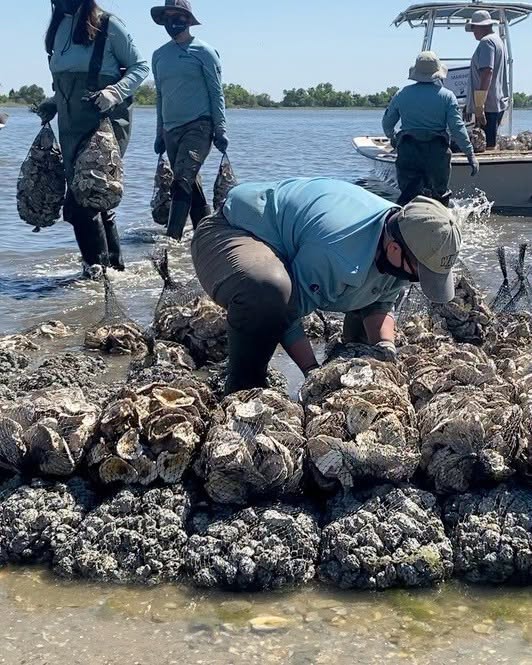
Through its Florida Oceanographic Oyster Restoration (FLOOR) program, the organization uses recycled oyster shell to rebuild reef habitat throughout the St. Lucie Estuary and Indian River Lagoon. Those shells provide the hard surface that tiny juvenile oysters, called spat, need to attach and begin growing. To date, Florida Oceanographic reports restoring nearly 60,000 square feet of oyster reef, with more than 2,400 volunteers contributing over 6,000 hours to the effort.
But building the reef is only part of the equation.
That's the question at the center of the research Toadfish is helping support.
Eastern oysters (Crassostrea virginica) are incredibly valuable ecosystem builders, but they are also vulnerable to disease. One of the threats Florida Oceanographic's research team is studying is dermo, a disease caused by the protozoan parasite Perkinsus marinus. Dermo has contributed to oyster mortality throughout the southeastern United States, and infection can be heavily influenced by the environment surrounding the oyster.
The St. Lucie Estuary and Indian River Lagoon give researchers a particularly interesting place to study that relationship. Salinity varies across these waterways, and both natural oyster reefs and older, artificially constructed reefs can be found throughout the system.
As part of this work, Dr. Krista and the Florida Oceanographic team compared oysters collected from natural and artificial reefs across both regions, measuring the prevalence and intensity of dermo infections.
What they found was significant: disease prevalence differed between the two regions, but not between natural and artificial reefs. Oysters living in the higher-salinity region experienced higher levels of infection.
In other words, whether a reef was naturally occurring or constructed wasn't the strongest predictor of disease. Environmental conditions—particularly salinity—appeared to matter more.
So, what is the research telling us?
That's an important distinction for restoration.
If researchers can better understand the conditions where oysters are less vulnerable to disease, future restoration projects can take those conditions into account when determining where new reefs may have the greatest opportunity to survive and grow. The team's work highlights the potential importance of identifying and protecting disease refuges areas where environmental conditions may naturally reduce disease pressure on oysters.
And this isn't happening in isolation. Florida Oceanographic already monitors oyster settlement, growth, and survival throughout these estuaries. Their researchers use oyster shells placed in the water to track when spat settle and how they develop over time, helping the organization measure reef health, changes in water quality, and the performance of restoration projects.
Their long-running water-quality program adds another layer to that picture. Since 1998, trained citizen scientists have monitored temperature, salinity, dissolved oxygen, pH, and water clarity throughout the St. Lucie Estuary and southern Indian River Lagoon. Today, that program includes 47 active monitoring sites across 10 zones.
Together, those data can help researchers better understand not just where oysters are living, but why they're succeeding—or struggling—there.
Through the Toadfish Conservation Coalition, we're proud to support Florida Oceanographic Society and their ongoing oyster research in the St. Lucie Estuary and Indian River Lagoon.
For us, this project represents an important side of oyster restoration that isn't always as visible as putting shell in the water.
Restoration isn't just about building more reefs. It's also about learning from the reefs that are already there, understanding the challenges oysters face, and using that knowledge to make future restoration efforts more effective.
The Florida Oceanographic research team is doing exactly that. Studying oyster populations, environmental conditions, disease dynamics, and the differences between natural and restored reefs to better understand where oysters have the greatest opportunity to thrive.
By supporting this work, we're helping advance the science that can inform smarter, more resilient oyster restoration throughout these important Florida estuaries.
That's work we're proud to help move forward.
Healthy oyster reefs don't exist on their own. They're connected to the water flowing around them, the shorelines beside them, the fish and wildlife that depend on them, and the communities working to protect them.
Sometimes helping those reefs means getting your hands dirty and putting oyster shell back into the water. Other times, it means looking through a microscope, monitoring salinity, collecting data, and asking why an oyster thrives in one place but struggles in another.
Both are restoration.
Florida Oceanographic also gives the local community plenty of ways to be part of that work. More than 250 volunteers contribute over 13,000 hours each year across the organization's conservation, research, education, animal-care, and visitor programs. Opportunities include water-quality monitoring and community beach cleanups, along with other volunteer roles at its Stuart Coastal Center.
Because the more we understand the ecosystems we depend on, the better equipped we are to protect them and keep Florida's waters thriving for generations to come.
#PutEmBack
Question 1
Lorem ipsum dolor sit amet consectetur adipisicing elit. Illum neque eaque, autem sit soluta, voluptatum libero magnam tempore ullam at harum vel, ad reprehenderit, nemo veniam quas in voluptas hic. Lorem ipsum dolor, sit amet consectetur adipisicing elit. Natus id officia omnis suscipit aut architecto repellat a quia eaque reiciendis blanditiis perferendis hic, nihil, mollitia. Iste velit aperiam, numquam dolorem.
Question 2
Lorem ipsum dolor sit amet consectetur adipisicing elit. Illum neque eaque, autem sit soluta, voluptatum libero magnam tempore ullam at harum vel, ad reprehenderit, nemo veniam quas in voluptas hic. Lorem ipsum dolor, sit amet consectetur adipisicing elit. Natus id officia omnis suscipit aut architecto repellat a quia eaque reiciendis blanditiis perferendis hic, nihil, mollitia. Iste velit aperiam, numquam dolorem.


